1. Introduction
Squirrels, rabbits and birds are not artists. However, humans may admire a bird's nest as being a "work of art," and may find the patterns in the snow made by squirrel or rabbit tracks pleasing. Yet, the shape of a bird's nest may indeed be a form of communication for birds, just as "art" is a form of communication for humans. What constitutes art is a very complex and hotly debated subject. When Jackson Pollock first experimented with expressing himself by flinging paint at a canvas, many saw his activity as a form of self-indulgence rather than art. As another example, some people collect maps and some of these maps are art, but not all maps are art.
April is
Mathematics Awareness Month, and this year's theme is
Mathematics and Art. There are, in fact, many arts (
music,
dance,
painting,
architecture,
sculpture, etc.) and there is a surprisingly rich association between mathematics and each of the arts. My goal here is to give some
pointers concerning these many connections.
One mathematical connection with art is that some individuals known as artists have needed to develop or use mathematical thinking to carry out their artistic vision. Among such artists were
Luca Pacioli (c. 1145-1514),
Leonardo da Vinci (1452-1519),
Albrecht Dürer (1471-1528), and
M.C. Escher (1898-1972). Another connection is that some mathematicians have become artists, often while pursuing their mathematics.
Mathematicians commonly talk about beautiful theorems and beautiful proofs of theorems. They also often have emotional reactions to proofs or theorems. There are nifty proofs of "dull" mathematical facts and "unsatisfying" proofs of "nifty" theorems. Artists and art critics also talk about beauty. Does art have to be beautiful? Francis Bacon's paintings may or may not be beautiful to everyone, yet there are few people who have no reaction to his work. Art is concerned with communication of emotions as well as beauty. Some people may see little emotional content in many of M.C. Escher's prints but it's hard not to be "impressed" by the patterns he created. Some find Escher's prints beautiful but with a different beauty from the great works of Rembrandt. Like art itself, the issues of beauty, communication, and emotions are complex subjects, but then so is mathematics.
Joseph Malkevitch
York College (CUNY)
2. Mathematical tools for artists
Art is born of the attempt by humans to express themselves about the experience of life. Art can take the form of writing, painting, and sculpture, as well as a variety of other forms of expression. There is art in the combining of function and aesthetics in such everyday objects as plates, cutlery, and lamps. Mathematicians have been able to assist artists by creating "tools" of various kinds for them. Such tools sometimes consist of theorems which show the limitations of what artists can do. One can not attempt to represent more than 5 regular convex polyhedra in Euclidean 3-dimensional space because mathematics shows there are only 5 such regular solids. Dodecahedra can be used to put one month of a calendar on each face but the number of faces of a regular convex polyhedron in Euclidean 3-space is 4, 6, 8, 12, or 20. There can be no others. A much more important issue is the realism with which artists can draw on a flat piece of paper what they perceive when they look out at their 3-dimensional world. If one looks at attempts at scene representation in Egyptian and Mesopotamian art, one sees that phenomena that are associated with the human vision system are not always respected. We are all familiar with the fact that objects that are far away from us appear smaller than they actually are and that lines which are parallel appear to converge in the distance. These features, which are a standard part of the way that 3-dimensional objects are now usually represented on a planar surface, were not fully understood before the Renaissance. It is common to refer to artists as using "perspective" (or "linear perspective") to increase the realism of their representations. The issues and ideas involved in understanding perspective are quite subtle and evolved over a long time.
The interaction between scholars and practitioners with regard to ideas about perspective parallels the interactions between theory and application that goes on in all the arenas where mathematical ideas are put to work. An artist may want to solve a problem better than he or she did in the past and will not always be concerned with the niceties of proving that the technique used always works or has the properties that the artist wants. An analogy for a more modern situation is that if the current system used to route email packets takes on average 7.2 units of time and one discovers a way of doing the routing in 6.5 units of time on average, one may not worry that one can prove that the very best system would do the job in 6.487 units of time.
Questions about perspective are very much in the spirit of mathematical modeling questions, since in the usual approach one is concerned with the issue of the perception of, say, a scene in 3-dimensional space on a flat canvas under the assumption that the scene is being viewed by a "single point eye." Yet, we all know that humans are endowed with binocular vision! We are attacking such binocular vision questions today, because we have the mathematical tools to take such questions on, while the artist/mathematicians of the past had to content themselves with simpler approaches.
A variety of people whose names are known to mathematicians (but perhaps not to the general public) have contributed to a theory of perspective. Though every calculus student knows the name of
Brook Taylor (1685-1731)
for his work on power series, how many mathematicians know that Taylor wrote on the theory of linear perspective? On the other hand every art historian will recognize the name of
Piero della Francesca (c. 1412-1492), yet how many of these art historians (or mathematicians) will be familiar with his contribution to mathematics? Similarly,
Girard Desargues (1591-1661) is a well known name to geometers for his work on projective geometry (in plane projective geometry there are no parallel lines), but few people involved with art are familiar with his work. The diagram below (a portion of a "Desargues Configuration"), familiar to students of projective geometry, can be thought of as a plane drawing of an "eye" point viewing triangles which lie in different planes.
Another contributor to the theory of perspective was
Johann Lambert, also known for having produced results which would follow from assuming that Euclid's Fifth Postulate does not hold. Though perspective is a well-mined area, this does not stop the flow of continued thoughts on the subject. For those accustomed to work on one-point or two-point perspective, there is the monograph of
D. Termes who
treats one- through six-point
perspective!
Related to the tool of
linear perspective is the branch of geometry known as
descriptive geometry. While descriptive geometry was widely taught in the 19th century, especially in schools of engineering, the subject is not widely known today. The reason in part is that computer software makes it possible for people not familiar with descriptive geometry to perform tasks which make explicit knowledge of it increasingly obsolete. Descriptive geometry provides a set of procedures for representing 3-dimensional objects in two dimensions. The 2-dimensional representation might be on either a piece of paper or a computer screen. These techniques are of great importance to engineers, architects, and designers. The design of, say, a large aircraft may involve tens of thousands of drawings. The roots of the subject lie with people such as
Albrecht Dürer (1471-1528) and
Gaspard Monge (1746-1818). If an artist, creative designer, sculptor, or architect can not get across his/her conception of how to manufacture or otherwise assemble a "creative" design, then the work involved might go unrealized. Descriptive geometry supports both constructive manufacture and creative design by giving procedures for showing how to represent proposed 3-dimensional creations on a flat surface.
To give some of the flavor of the issues involved, the diagram below shows in blue how parallel lines "project a triangle onto a line," while the red lines show how the same triangle is "projected" from the "eye" onto the same line:
A', B', and C' show where the vertices are moved by "parallel" projection and A'', B'', and C'' show where the vertices are moved by "conical" projection.
Here is a rather cute result which grew out of this interaction between mathematics and the needs of artists to represent three dimensions on a flat plane. The result is known as
Pohlke's Theorem. Karl Wilhelm Pohlke (1810-1876) was a German painter and teacher of descriptive geometry at an art school. He formulated this result in 1853, though the first proof seems to be due to K.H.A.
Schwarz (1843-1921) in 1864. The theorem is quoted in various levels of generality. Here is one version:
Theorem (Pohlke): Given three segments (no two collinear) of specified length (not necessarily the same) which meet at a point in a plane, there are three equal length line segments which meet at right angles at a point in 3-dimensional space such that a parallel projection of these segments maps them onto the three chosen line segments in the plane.
Intuitively, this means that if one wants to draw a cubical box in the plane, one can draw any triad of lines for a corner of the cube because there is some position of a cube in 3-space which maps to the given triad. Thus, in the diagram below the triad on the left can be completed to form a "cube," and there is some set of three orthogonal segments in 3-space which can be mapped using parallel projection onto the triad on the left.
Sometimes Pohlke's Theorem is referred to as the Fundamental Theorem of Axonometry. Axonometry, like descriptive geometry, deals with the problem of drawing 3-dimensional objects in the plane. Here is a
recent item coauthored by
Roger Penrose in this
spirit.
3. Symmetry
Art critics have evolved a language for discussing and analyzing art. It turns out that some mathematics can also be useful in analyzing art. Some art or pieces of art consist of things that are pleasing to the eye because they are
symmetrical in a mathematical sense. Although the study of symmetry has implicitly been done within mathematics for a long time, in some ways its systematic study is quite recent. It was Felix Klein (1849-1925) who called attention to the fact that one way of classifying different kinds of geometries is to look at the geometric transformations in each of these geometries that preserve interesting properties. In particular, it is of interest in Euclidean, spherical, or Bolyai-Lobachevsky geometry to look at the geometric transformations that are isometries. An isometry is a transformation that preserves distance.
Of course, it is important to keep in mind that many of the pieces of art that mathematicians (and others) analyze using mathematical ideas may not reflect attempts on the part of the artist to incorporate these mathematical ideas in his/her work. Just as someone who makes a cubical box may not realize that the cube is a regular polyhedron (one where all the vertices are alike and where all the faces are congruent regular polygons), a maker of a weaving may not know anything about isometries. The isometries in the Euclidean plane are translations, rotations, reflections and glide reflections. Thus, a mathematician may state which isometries are used in the design of a rug, but that does not mean that the designer of the rug invoked any mathematical thinking. Social scientists have used symmetry ideas and the conservatism of the mechanisms of cultural transmission in their studies. Archeologists and anthropologists have attempted to use symmetry ideas to date artifacts (pottery or fabrics) and to study trade and patterns of commerce.
A major tool in the analysis of
symmetry has been the concept of a
group.The group concept has a rich and complicated history with ties to the study of the theory of equations (attempts to show that one could not find formulas to solve quintic polynomial equations). By late in the 19th century, group theory was being used as a tool to help crystallographers understand the symmetry of crystals and other
naturally occurring structures. Out of this interest grew the work that made possible the classification of tilings and patterns using group theory considerations.
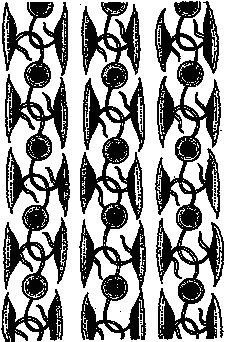
One can also look at the symmetry of a single motif or ornament. Examples of such motifs (illustrated from patterns used in batiks) are shown below. Such ornaments typically have rotational symmetry and/or reflection symmetry.
A more complex pattern such as the one below can be built up from simple motifs. Such patterns have translational symmetry in one direction. Designs or patterns of this kind are known as
strip,
band, or
frieze patterns.
The motifs used to make such frieze patterns may be isolated from one another or coalesce into a "continuous" geometric design along the strip. If a pattern has translations in two directions, then the pattern is often referred to as a wallpaper pattern.
Whereas an artist may choose to create a pattern with absolute and strict adherence in all details to have symmetry in the pattern, this is not all that common for "tribal" artists or artisans. Thus, if one looks carefully at a rug which at first view looks very symmetrical, it is common to see that at a more detailed level it is not quite totally symmetric either in the use of the design or of the colors used in different parts of the design. One can see the small liberties that are taken either because of the difficulty of making patterns exact by hand or because the artist wants consciously to make such small variations. In analyzing the symmetry of such a pattern it probably makes sense to idealize what the artist has done before applying some mathematical classification of the symmetry involved.
In the patterns shown above no color appears. We have a black design on a white background. However, in discussing the symmetry of a pattern one can study the symmetry involved if color is disregarded or by taking color into account. If you look at the batik below from a symmetry point of view you must idealize (model) what is going on to use mathematics. This batik is not infinite in either one or two directions. You must decide what colors have been used and what is the background color.
Many find it interesting to use mathematics to decide what symmetry pattern is involved for various interpretations of the whole or parts of a design.
E. Fedorov (1859-1919) enumerated the seventeen 2-dimensional patterns in 1891 in a paper which did not receive wide attention because it was in Russian.
P. Niggli (1888-1953) and G. Polya (1887-1985) developed the seven 1-dimensional and the seventeen
2-dimensional patterns in the 1920's; it was through this work that a mathematical approach to the analysis of symmetry patterns became more widely known. One extension of this work to color symmetry was accomplished by H. Woods in the 1930's. It turns out that there are 46 two-color types of patterns. Subsequently much work has been done with regard to
studying symmetry in higher-dimensional spaces and using many colors. Recently Branko Grünbaum and Geoffrey Shephard, in a long series of joint papers and in their seminal book Tilings and Patterns, explored many extensions and facets of pattern, tilings, and their symmetries. In particular, Grünbaum and Shephard explored the interaction between symmetry and the use of a motif. This enabled them, for example, to develop a "finer" classification of the seven frieze patterns and seventeen wallpaper patterns. Unfortunately, this work is not as widely known as it should be.
Many people have been instrumental in disseminating mathematical knowledge of symmetry and pattern to scholars outside of mathematics as well as to the general public. One of the most influential and early books of this kind was Hermann Weyl (1885-1955)'s book Symmetry. Also noteworthy among these popularizers are Doris Schattschneider, Branko Grünbaum, Geoffrey Shephard, Marjorie Senechal, Michele Emmer, H. S. M. Coxeter, Dorothy Washburn (an anthropologist), Donald Crowe and Kim Williams. These individuals called attention to the
use of symmetry as a tool for insight into various aspects of fabrics, ethnic designs and culture, architecture, and art, as well as to artists such as Escher whose work tantalizes people with a mathematical bent.
4. Mathematical artists and artist mathematicians
Not surprisingly, in light of the internal aesthetic qualities of mathematics, many mathematicians (and computer scientists) have chosen to express themselves not only by proving theorems but also by producing art. There are
many such individuals including
Helaman Ferguson,
Nathaniel Friedman (also see
this site),
George Hart,
Koos Verhoeff, and
Michael Field. Complementing these career "mathematicians" who are also artists is a group of people who are not mathematicians but who have drawn great inspiration from mathematical phenomena. Some such individuals are
Brent Collins,
Charles Perry, and
Sol LeWit (here are more samples of his
work). As might be expected, there are many architects whose work has a feeling of having been influenced by "technical capability." Though perhaps having only a tangential connection with mathematics, the
distinguished architect Frank
Gehry has discussed how the availability of CAD (Computer Aided Design) software has made it
possible for him to express himself in a way that would not have otherwise been possible.
Structural engineering has many ties with mathematics. If you are not familiar with the work of
Santiago Calatrava, you are in for a
treat. There have also been attempts of various kinds to generate art with algorithms. Some of this
work is rather interesting.
For the general public, there is one artist whose work, perhaps more than any other, is seen as having a mathematical quality. This artist was
M. C. Escher. The mathematical quality of his work is apparent even though Escher did not see himself as having mathematical talent. Yet despite his lack of formal study of mathematics, Escher approached many artistic problems in a mathematical way. Doris Schattschneider has been instrumental in calling to the public's attention Escher's work and its relation to mathematics. Escher was influenced by at least one very distinguished mathematician (geometer),
Harold Scott MacDonald Coxeter. Escher interacted with
Coxeter about the difficulties he was having with representing "infinity" in a finite region. Coxeter responded by showing the
connection to tilings of the hyperbolic plane. Coxeter has explained the details of this
mathematical connection. Mathematically active until his death, Coxeter recently passed away at the age of 96 (an obituary is
here). .
5. Polyhedra, tilings, and dissections
Drawing polyhedra was an early testing ground for ideas related to perspective drawing. Renaissance artists were involved in trying to build on historical references to "Archimedean polyhedra" which were transmitted via the writings of Pappus. What constituted a complete set of convex polyhedra with the property that locally every vertex looked like every other vertex and whose faces were regular polygons, perhaps not all with the same number of sides? Perhaps surprisingly, no complete reconstruction occurred until the work of Kepler (1571-1630), who found 13 such solids, even though one can make a case for there being 14 such solids. (Pappus-Archimedes missed one in ancient times. The modern definition of Archimedean solids defines them as convex polyhedra which have a symmetry group under which all the vertices are alike. Using this definition there are 13 solids, but there is little reason to believe that in ancient Greece geometers were thinking in terms of groups rather than in terms of local vertex equivalence, that is, the pattern of faces around each vertex being identical.)
In more modern times polyhedra have inspired artists and mathematicians with an interest in the arts. Inspired by polyhedra, Stewart Coffin has created a wonderful array of
puzzle designs which require putting together pieces he designed made from rare woods to form polyhedra.
Coffin's puzzles are remarkable for both their ingenuity as puzzles and their beauty. This beauty is a reflection of the beauty of the polyhedral objects themselves, but also the beauty of the rare woods he used to make his puzzles. Coffin showed creativity in selecting symmetrical variants of well-known polyhedra. Coffin's work, like Escher's, has been an
inspiration to others. Good
puzzles engender the same sense of wonder that beautiful mathematics inspires.
George Hart, whose background is in computer science, is an example of a person who is contributing to the mathematical theory of polyhedra, while at the same time he uses his skills as a sculptor and artist to create original works inspired by polyhedral objects.
There is a long tradition of making precise models of polyhedra with regularity properties. It is common at mathematics conferences for geometers to feature a models room where mathematicians who enjoy building models can display the beauties of geometry in a physical form. They complement the beauty of such geometric objects in the mind's eye. The beauty of polyhedral solids in the hands of a skilled model maker results in what are, indeed, works of art.
Magnus Wenninger is the author of several books about model making. His
models are especially beautiful. Here is a small sample, which only hints at the variety of
models that Wenninger has made over many years. His
models of "stellated" polyhedra are particularly striking.
A tiling of the plane is a way of filling up the plane without holes or overlaps with shapes of various kinds. For example, one can tile the plane with congruent copies of any triangle, and, more surprisingly, with congruent copies of any simple quadrilateral, whether convex or not.
Tilings are closely related to artistic designs one finds on fabrics, rugs, and wallpaper. Though there were scattered analyses at different ways of
tiling the plane that date back to ancient times, there was surprisingly little in the way of a theory for tilings of the plane as compared to what was done to understand polyhedra. Kepler did important work on tilings, but from his time until the late 19th century relatively little work was done. Unfortunately, not only was work on tilings sporadic but often it was incomplete or misleading. The publication of the monumental book by Branko Grünbaum and Geoffrey Shephard, Tilings and Patterns, changed this. Many new tiling problems were addressed and solved and a variety of
software tools for creating tilings (and polyhedra and playing games) of different kinds were developed. Daniel Huson and Olaf Fredrichs (RepTiles) and Kevin Lee (Tesselmania) developed very nice tiling programs but some of the locations where this software used to be available are no longer supported.
A more recent source of art inspired by mathematics has been related to dissections. A good starting place for the ideas here is the remarkable theorem known as the Bolyai-Gerwien-Wallace Theorem. It states that two (simple) polygons A and B in the plane have the same area if and only if it is possible to cut one of the polygons up into a finite number of pieces and assemble the pieces to form the other polygon. In one direction this result is straight forward: if one has cut polygon A into pieces which will assemble to form polygon B, then B's area is the same as A's area. The delightful surprise is that if A and B have the same area then one can cut up A into finitely many pieces and reassemble the pieces to get B. Where does the art come in? Given two polygons with the same area, one can ask for two extensions of the Bolyai-Gerwien-Wallace Theorem:
a. Find the smallest number of pieces into which A can be cut and reassembled to form B.
b. Find pieces with appealing properties into which A can be cut and reassembled to from B. These properties might be that all the pieces are congruent, similar, or have edges which are related by some appealing geometric transformation.
Greg Frederickson has
collected together a large amount of material about how polygons of one shape can be dissected into other polygons of the same area. These dissections concentrate on dissections of regular polygons (which may be convex or "star-shaped") into other regular polygons. One might expect that the mathematical regularity of the objects leads to aesthetic solutions. This turns out to be the case.
Frederickson also describes how with a suitable mechanism, one can address how to attach the pieces from one polygon and move them so that they create the other polygon. These dissections are known as
hinged dissections. The first way that comes to mind to hinge the pieces is to attach the pieces at their vertices. There are lovely examples of hinged dissections of this kind including ones that prove the
Pythagorean theorem geometrically by showing how one can cut the squares on the two legs of a right triangle and assemble the pieces to form the square on the hypotenuse. However, there is another ingenious way to do the hinging. This involves hinging the edges so that the polygons that are joined along these two edges can rotate with respect to one another. This type of hinging is known as twist-hinging. Frederickson arranged for several very attractive hinged dissections to be realized physically with polygonal sections of the dissection involved to be made of beautiful woods. For their beauty these
physical models draw heavily on the mathematics behind the dissections. For example, in one of the physically realized hinged dissections commissioned by Frederickson, a regular hexagon with a hole is twist-hinge dissected into a hexagram with a hole of the same area.
The mathematics behind this process is a way to dissect a hexagon with a hole into a hexagram with a hole. Based on this dissection Frederickson cleverly produced a hinge-twist dissection. This very attractive object is not very interesting as a puzzle but creates a lovely effect as one watches the unexpected transformation between the two shapes evolve as one manipulates the twist-hinged pieces.
6. Origami
Traditional origami was concerned with taking a single piece of paper and folding it into complex shapes, typically that of an animal or something representational. However, Tomoko Fusè revolutionized the world of origami from a mathematical perspective by popularizing "modular" origami. In modular origami one typically starts with congruent pieces of paper (usually squares) and folds each of these into identical "units." These units are then "woven" together to form highly symmetrical objects such as polyhedra, tilings, or boxes. By using appropriate colors, one can often construct very attractive paper models of a wide variety of polyhedra and tilings with attractive symmetry properties. The creativity involved in unit origami lies in the ingenious panels that have been developed and the way that the panels can be assembled. Fusè's books appear in the "art section" of book stores. Interestingly, for people with some experience in origami, those of Fusè's books which have not been translated into English still can be used because of the universality of the instruction system for folding origami (e.g. symbols for mountain folds, valley folds, etc.).
Parallel with the artistic aspects of origami constructions has been the development of a mathematical theory of origami. This has taken a variety of approaches. The elaborate
mathematical theory of what plane figures can be drawn using the traditional Euclidean construction tools of straight edge (unmarked ruler) and compass has an origami companion. What are the shapes that can be constructed using various rules (axioms) concerning the folding of paper? Thomas
Hull, Erik
Demaine and others have also studied issues related to
folding and origami. A major area of interest has been the study of the crease patterns (system of lines on the paper) which can be folded "flat." The mathematics needed involves ideas and methods somewhat different from what was done in the past in attempting to understand how a piece of a plane (a square of origami paper) could be transformed by a geometric transformation, because at the end of the transformation parts of the origami paper touch each other, though they do not interpenetrate other parts of the paper.
Here is an example of a spectacular proven result in this area. Suppose that after having folded a piece of paper flat, one is allowed to make one cut along a straight line with the goal of taking the pieces that are cut off and opening them up. What shaped pieces are possible in this way? The surprising answer is: Any graph consisting of vertices and straight line segments that can be drawn in the plane is possible! For example, one could cut out the shape of something prosaic like the letter "I" or the outline of a butterfly. This result was originally developed by Erik Demaine, Martin Demaine, and Anna Lubiw. Subsequently a different approach to the result was developed by Marshall Bern, Erik Demaine, David Eppstein, and Barry Hayes.
One can make many different kinds of polyhedral objects using modular origami. Here is a sample of origami models of
Helena Verrill:
Origami models of polyhedra use approaches where the panels become the faces of the polyhedra, so that the challenge becomes producing panels with different numbers of sides with the same edge lengths. One can also produce polyhedra which are "pyramided." By this I mean that the solids represent convex polyhedra with pyramids erected on each face. (Those are not stellations in the usual sense that geometers use this term.) Other polyhedra like these emphasize the edges of the polyhedron and in essence serve as rigid rod models for the polyhedra. They resemble Leonardo da Vinci's drawings that demonstrated emerging techniques of drawing polyhedra in perspective.
In addition to being beautiful objects, many of the
polyhedra that can be created using origami paper suggest mathematical questions of interest. Here is a simple example: One can make a cube out of six unit origami pieces. If these six pieces are all the same color, then one can make only one "type" of colored cube. Suppose that one has three panels of one color and three panels of another color. How many inequivalent cubes can one make?
The diagram below shows an origami construction based on
ideas of Thomas Hull and folded by
Joe Gilardi. At the mathematical level is a nested collection of tetrahedra folded from dollar bills. Many also see a work of art!
In the discussions above I have charted the tip of the iceberg of the connections between mathematics and art. These connections are good for both mathematics and art. Clearly, interest in the connections between mathematics and art will continue to grow and prosper.